Sunday, December 20, 2015
Negative-Calorie Foods and Their Connection to Weight Loss
Wouldn’t it be nice to eat certain foods and lose weight? That’s the thought behind so-called “negative-calorie foods” or foods you can eat that are so low in calories they technically shouldn’t count. They supposedly take up more energy to chew and digest than they contain, so they don’t contribute to your calorie surplus (a.k.a. weight gain). The question is: Do they work?
Negative-Calorie Foods and Their Connection to Weight Loss
Negative-calorie foods are usually fruits, vegetables and other low-calorie snack items—foods that we subconsciously label as “healthy” (check out the chart below for more examples). The idea that negative-calorie foods help with weight loss comes from simple reasoning:
1. You burn more calories eating these foods than they actually contain.
Negative-calorie foods are low in calories but high in fiber and water, with some items containing up to 90% water by weight. As you know, water adds volume but zero calories. Fiber, though a carbohydrate, is difficult to digest so you don’t extract as many calories from high-fiber foods compared to low-fiber foods. Fibrous foods force you to chew more often, which theoretically burns extra calories (though not many!).
Examples of Negative-Calorie Foods
FRUITS
Blueberries
Citrus fruits
Melons
Apples
Peaches
Grapes
Apricots
Tangerines
Cherries
Prunes
VEGETABLES
Celery
Lettuce
Onions
Broccoli
Cauliflower
Spinach
Cucumbers
Beets
Carrots
Green beans
Spinach
Turnips
OTHER
Air-popped Popcorn
Rice Cakes
Edamame
Bulgar
Wheat Bran
Shirataki Noodles
Egg whites
2. You feel fuller from these foods so you eat less unhealthy foods.
The volume from the water and fiber doesn’t contribute much to calories but impacts satiety. By filling up on negative-calorie foods, you feel fuller and are less apt to choose energy-dense foods full of empty calories (think: potato chips).
While these are two enticing reasons, the reality is you can’t just count on negative-calories foods to help you lose weight because:
1. You don’t use as many calories to process and digest food as you might think.
According to the Academy of Nutrition and Dietetics, our bodies only burn about 5–15% of calories from this phenomenon. For someone who needs 2,000 calories per day, only 100–300 calories would be used to process and digest foods. You could consume way more calories than that while watching a movie and eating a bowl of grapes!
2. Low-calorie foods may not be as satisfying as a smaller amount of energy-dense foods.
You can still overeat low-calorie foods and contribute more calories than you think to your daily intake.
Rethink Negative-Calorie Foods
A glance at the negative-calorie foods chart above might have you thinking: “Wait a minute, these foods look pretty healthy!” You’re correct. You should choose fruits and vegetables often as part of a balanced, healthy diet; in addition, the fiber in these foods make them beneficial for weight loss. The caveat, though, is your relationship with these foods. If you view negative-calorie foods as a way to put your mind on autopilot so you can eat without being mindful of calories and portion sizes, think again.
Regardless of the dietary makeup of the food you’re eating, there is no research to support that more calories are used to metabolize a food than the number of calories the food contains. When it comes to weight loss, choosing a variety of foods, burning energy through exercise, and learning about your habits through tracking is the most sustainable plan.
Via My Fitness Pal
Friday, December 11, 2015
How To Get Into the Fitness Zone
You may have heard people talk about a runner’s high or being in the zone. Sport psychologists call it flow state, but it all means the same thing: it’s the moment in time when you both feel and perform your absolute best. On average, people can easily access about 65% of their absolute strength. When you get into a flow state, you have the opportunity to push your strength to its absolute threshold. In this state, you’ll jump higher, lift more, reach farther, and hold poses longer – all while loving every minute of it!
The state is the result of your brain releasing five brain chemicals known as neurotransmitters into the body. To easily explore the differences between them, let’s enlist the help of some old friends: The Muppets.
Dopamine most closely resembles Elmo. Enthusiastic, engaged, and always wanting to experience new things, Elmo continues to seek adventure and creativity. Even when he doesn’t have all the skills necessary to do what he wants, he focuses and gets physically energized to perform the best he can.
Norepinephrine can be compared to Animal. This wild drummer is full of intense energy and keeps himself locked on select targets (e.g. the drums) which keeps all other distractions at bay.
For endorphins, we can look to How to Get Into the Fitness Zone Bear, the group’s resident comedian who wants nothing more than to relieve everyone’s pain and produce pleasure with his jokes.
Anandamide is Gonzo, that daredevil who takes pride in everything that he does. Gonzo doesn’t often let fear get in his way of experimenting with new acts. In fact, his positive state prepares his body for even the most painful and ill-advised performances.
Lastly, serotonin is the one and only Kermit the Frog, the Muppet everyone calls upon to help them cope with adversity. He’s also good at giving everyone warm and fuzzy feelings long after the show is over, despite being cold-blooded.
When you’re in a flow state, all five of these neurotransmitters act as powerful painkillers and allow you to physically and mentally reach new heights.
Here are three things you can do to help yourself achieve a flow state:
1. Clear Process Goals. Flow is not about having clear outcome goals such as finishing a workout or losing 10 pounds. It’s about using clear goals to help you stay in the present moment. Before you’re about to perform an exercise, set a clear goal. It could be one more rep, five more seconds, lifting two more pounds, etc. Clear process goals center your mind, narrow your focus, free you from distractions, and create self-confidence.2. Get Feedback. The more you know how you’re doing and the faster you can course correct any issues, the greater your chances of finding flow. While performing each exercise, quickly assess your technique and effort. Ask yourself if there is anything you should correct or if you can give more effort. When you can quickly and immediately assess your performance, you can also quickly and immediately figure out if anything needs to be improved for the next set. With this tight feedback loop, you continue to stay in the present moment, feel in control and energized, and believe in your ability to push your limits.
3. Challenge Yourself. Understand that your attention will be most engaged when you choose an exercise that is just above your current ability level. Tasks that are too challenging elicit fear and self-doubt. Tasks that are too easy make room for distractions.
Via: Team Beachbody Blog
Thursday, December 10, 2015
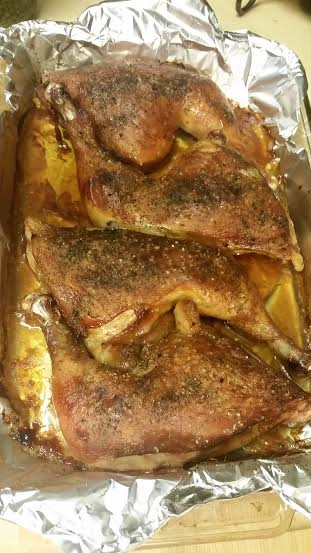
Dill Baked Chicken Quarters
Ingredients:
4 skin-on chicken leg quarters, with bone
1⁄2 cup (low sodium) soy sauce
1 teaspoon garlic powder
1 teaspoon sea salt
1 teaspoon seasoning salt
1 teaspoon dill weed
Directions
- Preheat oven to 375.
- Line a large glass baking dish with foil.
- Remove excess fat from chicken quarters.
- Separate the skin from the chicken, taking care that the skin stays attached at most points on the chicken. (You just want a flap. Do not remove the skin).
- Brush the chicken (under the skin) with soy sauce.
- Sprinkle some garlic powder, seasoned salt and dill weed on the chicken under the skin (I estimated the 1 tsp measures. Use as much or as little as you're comfortable with) and rub into the chicken.
- Arrange the leg quarters in the pan, skin side up, taking care not to crowd. They need space to cook properly.
- Brush both sides of the leg quarters with soy sauce.
- Sprinkle the skin with garlic powder, seasoned salt and dill weed (to taste).
- Place on middle rack in over and bake uncovered for an hour.
- After an hour, increase oven temp to 400 and bake 15 minutes.
- Chicken is done when internal temp reaches 165 (insert meat thermometer at thickest part of thigh, taking care not to touch the bone).
- Let stand for 5 minutes before serving.
Tuesday, December 8, 2015
Peppermint Mocha Latte
Calories in one Tall nonfat Peppermint Mocha Latte with no whip (add 70 calories and 7 grams of fat for whip):
Hmm. This prompted me to ask our incredible nutritionists to whip up their own version. I couldn’t be happier, and I think you’ll love it too. If you swap almond milk for nonfat milk and leave out the honey, you can enjoy it vegan.
Total Time: 10 min.
Prep Time: 5 min.
Cooking Time: 5 min.
Yield: 1 serving
Ingredients:
½ cup nonfat milk (or unsweetened almond milk)
2 Tbsp. unsweetened cocoa powder
½ tsp. raw honey (optional)
¼ tsp. pure peppermint extract
1 cup brewed black coffee (or 1 shot espresso)
1 fresh mint leaf (for garnish; optional)
Preparation:
1. Bring milk, cocoa powder, and honey (if desired), and peppermint extract to a boil in medium saucepan over medium heat, stirring occasionally.
2. Remove from heat; mix vigorously with a whisk until frothy.
3. Pour coffee into a large serving mug; top with milk mixture.
4. Garnish with mint leaf if desired.
Via: Team Beachbody Blog
Monday, December 7, 2015
The Best Foods to Fight Fatigue
Exhaustion isn’t a good look on anyone, but it’s all too easy to burn the candle at both ends in the always-connected world we live in. And when that energy slump hits, you need help. But that doesn’t mean downing a dozen cups of coffee or reaching into the candy bowl.
Sugar and caffeine will give you a quick rush, but that’s often followed by a crash. So if you’re searching for sustained energy, look for food with complex carbs, protein, and fiber. We put together this cheat sheet of things to eat and drink to beat fatigue—and a few foods that sabotage your efforts to get pumped up.
The Best Foods
1. Water
The next time you’re feeling drained, try guzzling good old H2O. Dehydration may actually be at the root of your fatigue. It can lead to headaches, ruin your concentration, and put you in a sour a mood. So hit the watercooler stat.
2. Chia Seeds
Talk about something small but mighty. Chia seeds help with hydration by absorbing 10 times their weight in water. Plus, they have the right ratio of protein, fats, and fiber to give you an energy boost without a crash.
3. Bananas
Consider this the green light to go bananas when you’re running low on fuel. In one study, researchers discovered that eating bananas worked as well as sports drinks at keeping cyclists fueled. The potassium-packed fruit also includes a bunch of good-for-you nutrients (like fiber and vitamin B6) that you won’t find in a bottle of Gatorade.
4. Quinoa
With all its protein, fiber, and iron, quinoa is the perfect thing to reach for when you’re looking to recharge. And if you need an on-the-go upper, whip up these quinoa muffin bites and grab ‘em before hitting the road.5. Green Tea
By now, it’s no secret that green tea has a slew of health benefits. You can add putting some pep back in your step to the long list. The combination of caffeine and L-theanine give you energy without the jitters. Bonus: Research suggests that green tea boosts brainpower as well, which may come in handy when you’re down to the wire at work. Take the time to brew the tea yourself because store-bought varieties often have lots of added sugar.

6. Oatmeal
The cozy breakfast food—though, let’s be honest, you can enjoy it any time of the day—will keep energy levels up. That’s because it’s high in fiber and comes with a decent dose protein. Plus, oatmeal has a low glycemic load, a fancy scientific way of saying it stabilizes blood sugar levels. (Just make sure to steer clear of instant oatmeal packets, which can be packed with sugar and salt.) Oatmeal is also super versatile—just take a look at these 30 delicious recipes to keep food boredom at bay.
7. Almonds
Certain kinds of fat are friends, not foes, particularly when you’re talking about replenishing your energy. And almonds are packed with healthy monosaturated fats that are just what your body needs for a pick-me-up.
Foods To Avoid
© istock/Getty Images White bread
8. Beans
Beans keep you going thanks to a stellar trio of carbs, protein, and fiber. The protein fills you up, the carbs provide energy, and the fiber helps regulate blood sugar. Black beans in particular are your BFFs when it comes to an energy boost—try this black bean soup recipe next time your tank needs refilling.
9. Whole-Wheat Bread
Your body needs carbs for energy, but not all carbs are created equal. Whole-wheat bread is great for a long-lasting energy kick. It's is a complex carb, meaning it raises your blood sugar gradually instead of hiking it up at turbo-speed.
Foods To Avoid
1. Honey
Sure, honey has some serious health benefits, but it’s not something you should be reaching for if you’re looking for sustained energy. Adding a few teaspoons to your tea or yogurt will give a quick rush of energy that spikes your blood sugar, which means a crash can follow.
2. Energy Drinks
3. White Bread
While complex carbs keep your energy levels in a steady state, simple carbs, like white bread, can take your blood sugar on a rollercoaster ride. Not what you want when you're keeping a busy schedule.
4. Candy
There’s a reason you’re always hearing about sugar crashes. As anyone who’s made their way through their Halloween loot can attest, an energy low inevitably follows. While sweets may give you a quick hit of energy, it’s only a matter of time before you once again find yourself dragging. After all, candy’s made up of simple carbs and sugar (which spikes blood sugar only to let it drop way back down). How sweet it isn’t.
5. Junk food
It’s a cruel fact of life that the most accessible, easy-to-grab, and oh-so delicious foods wreck havoc on energy levels. Research has found that diets high in processed food tend to lead to weight gain and a more sedentary lifestyle.1 Talk about a lose-lose situation.
More on MSN
5 ways to lose weight in a hurry
More on MSN
5 ways to lose weight in a hurry
3. White Bread
While complex carbs keep your energy levels in a steady state, simple carbs, like white bread, can take your blood sugar on a rollercoaster ride. Not what you want when you're keeping a busy schedule.
4. Candy
There’s a reason you’re always hearing about sugar crashes. As anyone who’s made their way through their Halloween loot can attest, an energy low inevitably follows. While sweets may give you a quick hit of energy, it’s only a matter of time before you once again find yourself dragging. After all, candy’s made up of simple carbs and sugar (which spikes blood sugar only to let it drop way back down). How sweet it isn’t.
5. Junk food
It’s a cruel fact of life that the most accessible, easy-to-grab, and oh-so delicious foods wreck havoc on energy levels. Research has found that diets high in processed food tend to lead to weight gain and a more sedentary lifestyle.1 Talk about a lose-lose situation.
Via : msn.com
Via : msn.com
Monday, November 23, 2015
What kind of Workout Is Best For You?
If you’re unsure what type of workout can deliver not only the results you’re looking for, but also the incentive to do it enough to even see results, take heart. Everyone struggles with this at some point—even the fittest people at the gym.
The key is finding something you actually enjoy doing so that you can stay consistent and excited about it. Whether that’s a different workout every week or a daily power walk, select something that’s realistic for your life and easily accessible so you have no excuse not to get out there and exercise. Read on for ideas of the types of workouts that might work best for you.
If you … get bored easily: Mix it up! If just the thought of hitting the elliptical makes you yawn, then you’re probably the type of person who needs a little more variety in your exercise diet. Doing different workouts throughout the week will keep you on your toes—and will allow you to work on strengthening different parts of your body. Set up a loose schedule for yourself so that you stay on track (say, cardio every Wednesday and strength work on Sundays). Or look into a service like ClassPass, available in multiple major cities, where you can test out a gamut of workouts, from Bikram to barre. Who knows, maybe one will stick—and at least you’ll have plenty of fun in the process.
If you … thrive on goals: Train for a 5K. Or a 10K. Or a 24-hour spin-a-thon. Whatever looms large in your head as something slightly out of your reach, pick it and go for it. (Just be realistic about your goal: If you’ve never run a step, 6.2 miles may be too tough of a challenge.) The initial act of registering for the event—especially paying the entry fee—will make you more motivated to get after the goal. Then come up with a training plan that works for your fitness level and lifestyle. Give yourself at least 12 weeks to prep for the event, then plug workouts into your calendar with automatic reminders so that you stay on track with your training. And when you cross that finish line? Celebrate your accomplishment—then go for an even bigger goal.
If you … are too busy to make it to the gym: Get it done at home. Set yourself up for at-home exercise success by investing in a few key fitness items: a yoga mat, medicine balls or kettlebells and light free weights. Then carve at least 30 minutes into your day for sweating it out. (Need a jump start? Check out these low-impact cardio workouts.) Do yourself a favor, and track and share your workouts on MapMyFitness so that you can see your progress—and stay motivated to get it done on the daily.
If you … are supersocial: Get into a group. Join a boutique cycle studio, a local running club or a Masters swim team, or check out CrossFit. Diving into a team environment is fun but also, more importantly, it holds you accountable since it’s much more obvious when you bail (and when you’re slacking). Plus, when the workout gets supertough, you’ll get that “we’re-all-in-this-together” vibe that’ll have you pushing until the end. Then you can all go out for happy hour or brunch together afterward to toast your hard efforts. Bonus!
If you … are prone to stress: Zen out. The obvious choices here are yoga and Pilates, where you are forced to slow down, focus on your breathing and really tune into your mind-body connection. (Or try these stress-reducing moves that increase flexibility.) But other activities can provide just as much internal peace and with an even better cardio boost. Try swimming laps or going for a hike in your favorite scenic spot. Whatever you do, don’t skip your workout: Studies show that just five minutes of aerobic exercise can begin to stimulate antianxiety effects.
Via: My Fitness Pal
Monday, November 9, 2015
Understanding The 21 Day Fix Program
One of the more difficult parts of starting any new diet or nutrition program is figuring out portion control. The color-coded 21 Day Fix containers were created to help solve this problem and make portion control easy and intuitive and get you away from the hassle of calorie counting. If it fits and it’s on the approved food list, you can eat it!
How the 21 Day Fix Containers Work
There are six colors corresponding to six different types of foods:
The green container is for vegetables. These can be cooked or raw, sliced or chopped. Some examples include lettuces, kale, squash, peppers, mushrooms, and onions. Go ahead and really squish the lettuce into there to create a voluminous salad!
The purple container is for fruits. Berries can easily fit into this container as can grapes and cherries, but you’ll want to cut larger fruits like watermelon, or fruits with pits, like peaches.
The red container is for protein. Fill it with chicken breast, yogurt, eggs, tofu, or shellfish. For some of the other protein, consult the food list in your guide.
The yellow container is for more caloric carbs, as well as starches. This is where you’ll fit in foods like rice, beans, sweet potatoes, and whole-grain pasta into your diet. For foods that don’t easily fit into your container such as waffles and tortillas, the portion amounts are in your 21 Day Fix guide.
The blue container is for healthy fats. Mashed avocado, nuts, cheese, and hummus are just a few of the things you can put in this container.
The orange container is for seeds and dressings. It is the smallest and is used for calorie-dense foods like seeds, olives, coconut, and 21 Day Fix-approved dressings.
There is also a teaspoon measurement included in the 21 Day Fix program, and this is for oils and butters, such as olive oil and peanut butter. A teaspoon is not provided with the containers, so you’ll need to use your own. (And who doesn’t have a teaspoon in their kitchen?)
How To Use Them
Now that you know what goes in the containers, it’s time to use them. Although you don’t have to count your calories each day, you should use page 4 of your guide to figure out approximately how many calories you need in a day. Once you do, take a look at the 21 chart on page 19 that will let you how many containers of each color you should eat each day for your calorie range. If you’re paying attention to macronutrient percentages, you’ll notice that the plan is roughly 40% carbohydrates, 30%protein, and 30% fat.
Although the guide contains recommendations for how much of one type of food can fit into a container, you can mix and match foods of the same category to fill a single container. For example, if you don’t want to use a whole green container for spinach, then you can fill one half full of spinach and the other half full of carrots, and it will still equal one green container.
As convenient and transportable as the containers are, you don’t have to eat out of them. You can measure out the portions in the containers and then empty the container out onto a plate or into a bowl.
Why the 21 Day Fix Container System Works
You don’t have to count calories. You only count containers. And it’s a lot easier to keep track of three green containers than x number of calories.
It’s definitely enough food. Often when people begin this program, they find that they’re full even before they’ve finished all their container portions for the day. That’s because healthy food has more volume than junk food. If you find you find this is the case for you, only eat what you can, but make sure to eat a little from all the containers instead of just filling up on your favorite kind and avoiding what you like the least.
Via:Team Beachbody Blog
Subscribe to:
Posts (Atom)